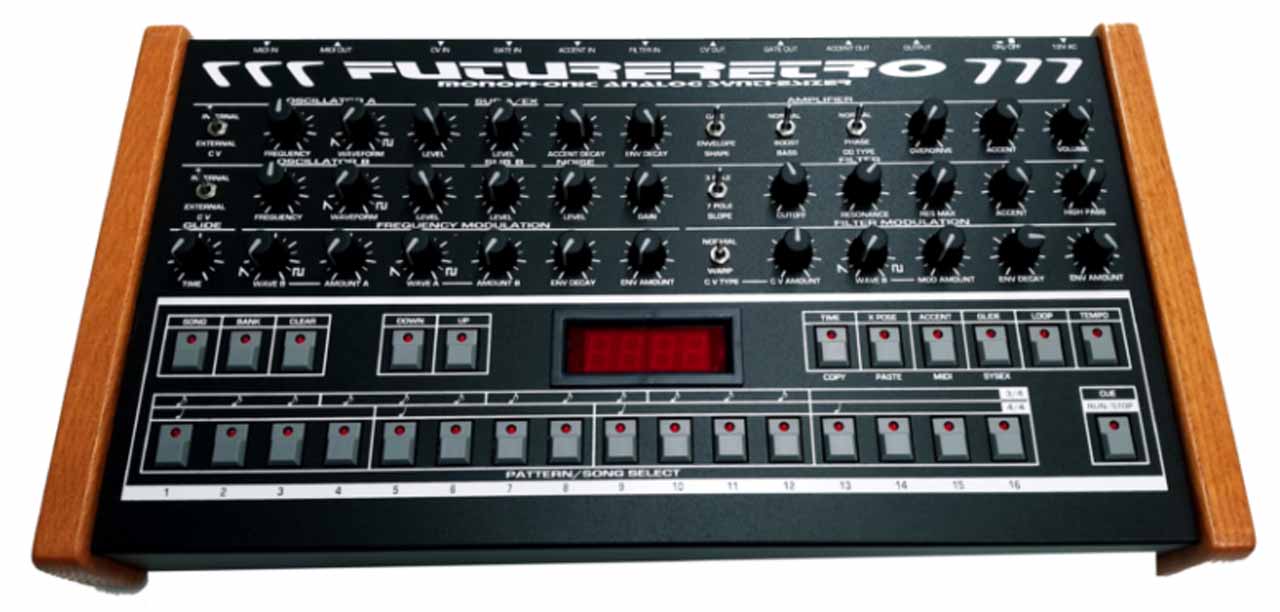
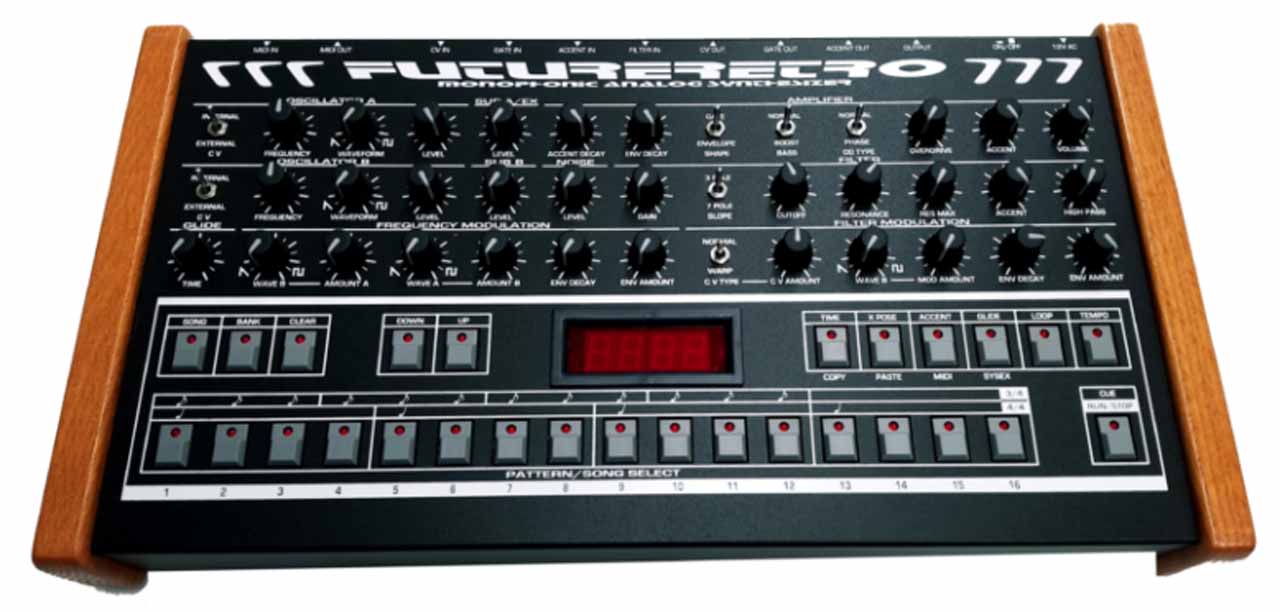
The 777 is a monophonic analog synthesizer with a digital sequencer. Built with the highest quality of components, the 777 is housed in a rugged aluminum chassis, has solid cherry end pieces, with top of the line knobs, switches, and electrical components. This machine is built to last.
The 777 is capable of reproducing the oh-so-famous sound of the TB-303 in every way, but that’s the least of it. TheTB-303 has only six knobs and one switch to control the sound, while the 777 has all these, plus five times more. There are 32 knobs and 7 switches to be exact, all instantly available with their single dedicated feature. The sequencer part of the synthesizer contains 28 illuminated keys, keeping all the features readily available for the user to tweak at any time. No menus, no virtual analog synthesis–this is the real thing!
Not only can the 777 recreate the TB-303 sounds to a “T” (or should we say “TB”), but it can also produce everything from deep basses to lead synthesizer parts, electronic percussion (kick drums, high hats, snares, toms, etc.), plus all the crazy ambient sounds you can dream of. This is the instrument of the future!
It’s fat, it’s warm, it’s fuzzy, and it’s packed with oodles of cool features. Let’s start with the seven possible audio sources. There’s Oscillator A and B, which both have a continuously variable waveshape from saw tooth to square. Then there’s Sub Oscillator A and B, each being one octave in pitch lower than their respective oscillator and both having square waveforms, with the exception that Sub A has a higher frequency content than Sub B. Also available are a white noise source and an external input jack that allows any external audio to be routed through the filter and amplifier section. And, the filter is capable of self-oscillation, producing sine waves.
For frequency modulation, you can modulate Osc A’s frequency with Osc B and Osc B’s frequency with Osc A. An envelope is also provided to sweep Osc B’s frequency.
The Filter section contains a selectable 3-pole or 7-pole lowpass filter complete with cutoff, resonance, res max, and accent controls. A highpass filter is provided with an adjustable cutoff. A pre-filter gain stage is also standard to fatten up the oscillators.
On the Filter Modulation section, a selectable CV-type switch is present with normal (Standard key follow type), and warp modes. The control voltage amount is also adjustable. Then there’s the continuously variable waveshape control to set the shape for Oscillator B’s frequency to modulate the filter, plus its amount control. There’s also a dedicated envelope with adjustable decay time and amount controls.
Finally, in the Amplifier section, there’s an accent decay and normal decay control for the amplifier’s envelope. You can select either the envelope or a gate to control the Amplifier section. There’s a bass control switch to select either normal or boost.