- Affordable, fully programmable poly synth with a 100% analog signal
path.
- Classic, real analog sound—including legendary Curtis analog low-pass
filter.
- Four-part multitimbral capability with four separate outputs.
- Combo Mode for huge unison patches, stacked sequences, and "modular-style"
poly sounds.
- Expandable: poly chain with other Tetras, Prophet '08, and Mopho for
expanded polyphony
- Just 7.9" x 5" (20.07 cm x 12.7 cm).
- Free editor for Mac OS and Windows.
Overview
Tetra is our next-generation analog poly synth. Tetra takes
the award-winning sound and features of Mopho, multiplies them by four, and
packs them in a box less than half an inch larger!
Tetra has multiple personalities. It is a four-voice, analog
poly synth, a sort of “mini Prophet.” It's a four-part, multitimbral synth with
separate outputs, essentially four Mophos in one very compact box. And
it’s a voice expander for other Tetras or the Prophet ’08.
Outside the Box
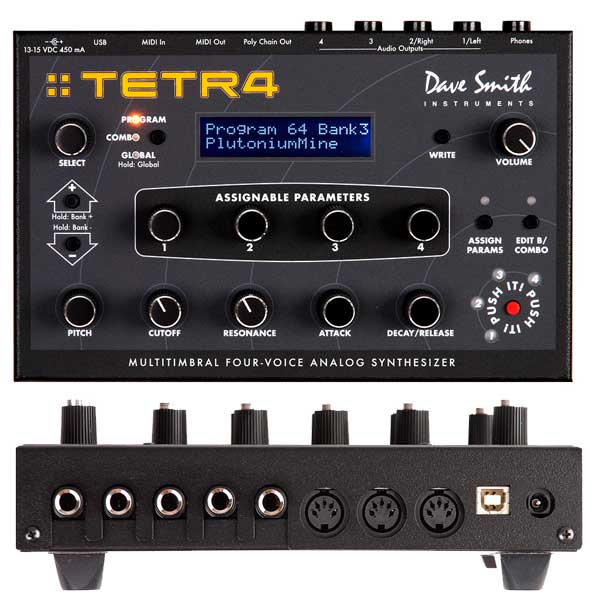
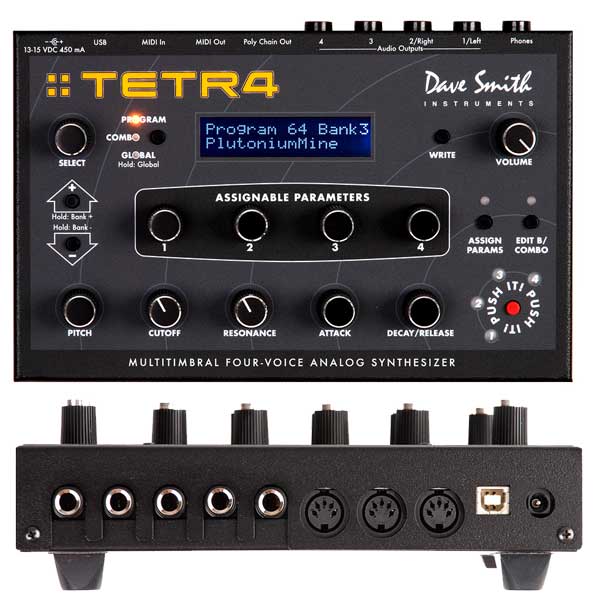
Physically, Tetra is
similar to Mopho, with four assignable parameter controls per program and a row
of controls dedicated to the most commonly used performance parameters. All of
the parameters can be accessed from the front panel and Tetra is fully
programmable. A free, downloadable editor is available for Mac OS and Windows to
facilitate more comprehensive tweaking.
Most of the rotary controls are detented encoders, but
Cutoff and Resonance are potentiometers, allowing full sweeps with a single
turn. The Push It button is a manual trigger to play notes and latch sequences
on without the need for a MIDI controller.
Audio is output in mono, stereo, or per voice, via the four
audio output jacks. There is also a headphone out. MIDI communication is by
standard MIDI in and out jacks or USB. Poly Chain Out is a special, dedicated
MIDI output to chain multiple instruments for increased polyphony.
Under the Hood
The voice architecture is
based on the Prophet '08, but with the addition of a sub-octave generator for
each oscillator and a fully programmable feedback loop for each voice. That
breaks down to two DCOs, a resonant low-pass filter, three DADSR envelope
generators, four LFOS, deep modulation routing, an arpeggiator, and a 16 x 4
analog-style step sequencer per voice. Feedback is capable of producing
effects ranging from mild distortion to fairly extreme harmonic instability.
(That's a good thing.) The possibilities are nearly endless. And the audio
signal path is 100% analog.
Tetra a la Mode
In Program Mode, Tetra
is a four-voice, polyphonic synthesizer with four banks of 128 programs. As with
the Prophet '08, each program contains two layers—each layer is essentially a
separate patch—that can be used to create keyboard splits or stacked sounds.
Banks 1 and 2 are the Prophet '08 factory programs; banks 3 and 4 are a
combination of Mopho and new programs.
In Combo Mode, a different program can be assigned to each
of the four voices. Combos can be used for mammoth unison patches or for
triggering up to four different 16 x 4 sequences—each with its own
program—simultaneously. Combos can also be used to create "modular-style"
polyphonic patches, where each voice plays a different program, with a slight
variation on the same sound or even a drastically different sound.
In Multi Mode, Tetra becomes a multitimbral sound module
capable of playing four monophonic parts on four MIDI channels, with separate
outputs for each voice. Coupled with a MIDI sequencer and DAW, Tetra can play
complex arrangements or analog drum parts with each part individually processed
and recorded to its own track.
This One Goes to 12...and 16
Up to four
Tetras can be poly chained for eight, twelve, or sixteen voices total. When used
with a Prophet '08, up to two Tetras can be poly chained for a maximum of
sixteen voices. In addition, the Prophet's front panel controls map directly to
almost all of Tetra's parameters, so the Prophet acts as a programmer and
control surface. And a Mopho can be connected to Tetra's Poly Chain Out for
five-voice operation.